NPO法人 アジア留学生サポートセンター|アジアから日本に集まる留学生・実習生のサポート

-

-

-

-

-

-

-

・・
・
・
2017.12
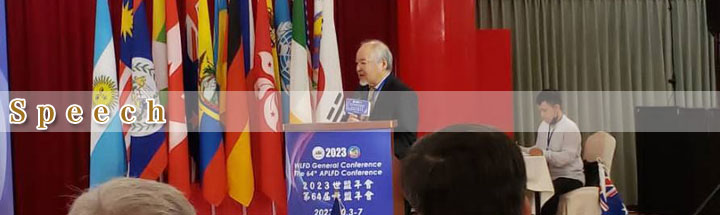
APLFD Taiwan Round Table
Japan Chapter Executive Committee
Hisashi Hanibuchi
I am very grateful to have been introduced at the 60th anniversary conference of WLFD and to be invited to attend the APLFD held this time in conjunction with the 65th anniversary of WLFD. Personally I have deep links with Taiwan. My wife is half-Japanese and half-Taiwanese, and my son has started a company and is permanently resident in Taiwan, and this year my first grandchild was born in Taiwan. So all my family is very pro-Taiwanese. There are three Japan experts whom I respect: the first is the former president of Taiwan whom everyone knows, Lee Teng-hui, who while he is advanced in years has shown wise and strong leadership which has left a great mark on Japan, as I have studied in his books. Another is Kin Birei who has studied at Waseda and in England, and has become a Japanese citizen. She is beautiful and her wonderful lectures are always to packed houses, while she has over 100,000 followers on YouTube. At a lecture given at Yasukuni shrine for the war dead she said that it was natural to venerate those who had sacrificed their lives for the country, and that if other countries should object they should be told it is “none of your business”.
The third is the scholar Ko¯ Bun'yu¯ who has been a university professor in Japan for many years and has written more than ten famous books about the history of Taiwan, Japan, Korea and China. For Japanese who are critical of their history he provides confidence and courage from an academic standpoint, and is a strong ally.
As we are two island nations which share a common geopolitical destiny, I hope that he will work more and more to deepen our most important relationship. To speak simply of Japan’s political and economic situation, in the post-war period the Abe government is the second long-term stability government. The policy of Abenomics has successfully brought Japan out of worrying deflation, creating 3.5 million jobs in four years, with unemployment at just under 3% being almost a labour shortage, and labour being positively imported from overseas.
The second longest economic upturn since the war is continuing. From the diplomatic standpoint also the prime minister has been more active than any of his predecessors, taking a leading role at summit conferences, meeting 11 times with the US and also Asia, Europe and Africa, pursuing a global diplomacy. Domestically also the right-of-centre parties have taken more than two thirds of the seats in parliament, and I think he will be able to realise much-needed reform to the constitution which has not had one word altered for 70 years, and it will be possible to create a normal sovereign state and put the Self-Defence Forces on a sounder footing by gaining the consensus of the people. At home things are going smoothly, but as you know the most urgent topic is the provocative North Korean missile threat from a national security standpoint the only way to deal with the threat and solve the problem of kidnapped citizens and secure the peninsula is by strengthening sanctions from Japan, America and China. The North Koreans believe that America’s attacks on Iraq and Libya were because these countries had no nuclear deterrent, which is why they are eating grass in their determination to develop missiles and nuclear weapons. At last their technology has produced an ICBM which in a lofted orbit reached the height of 4475 kilometres, and which in a normal orbit would reach the whole of the United States (13000 kilometres), and in a few years it is said they may have the capability to produce nuclear warheads also.
President Trump appears to get on well with Prime Minister Abe and when he visited Japan they played golf, and dined together six times. However, when missiles flew over Japan Trump is said to have called Abe on the phone and said “Shinzo, you are a samurai, aren’t you? Why don’t you shoot them down?” I don’t know whether Trump knows who created the Japanese constitution or why, but after Japan lost the war, first we were forced to disarm, and then a constitution was created with grammatical errors in a very short time by GHQ. The right to self–defence and to make war were denied. Coercion by war or force of arms and the exercise of military power were eternally renounced as a way of settling international disputes. Japan may not keep land, sea or air forces or any military power, and so on.
Even if Japan is seventh in the world in terms of military might, and the SDF may act as a rescue force in natural disasters, it is not recognized as a military force. Only if an enemy attacks may Japan defend herself. The Japanese have no wish ever to make war again, and they believe this Peace Constitution has maintained peace; moreover, over half the Japanese people are against strengthening the military and revising the constitution. In reality, alliance with America allowed Japan to shelter under the nuclear umbrella, but Trump is unpredictable and the rising maritime power of China are causing dramatic changes in Asia, and Japan is facing the greatest national crisis since the Second World War. According to the Gallup polling organization based in Geneva only 11% of Japanese are ready to fight for their country, which is the lowest percentage in the world. In Morocco and Fiji it is 98%, in Vietnam and Pakistan 89%, China 71%, America and South Korea in the 40% range.
At the beginning of the 1990s when the US-Soviet Cold War which had divided the world into two camps came to an end, by the victory of democracy over communism, the American scholar of international politics Francis Fukuyama published his bestseller The End of History. He surely could not have imagined in his wildest dreams that such an extremely poor and small country as North Korea should threaten America with ICBMs or that a rising China would ever propose dividing control of the Pacific and Atlantic with America. Rather than the end of history there are religious and racial conflicts and refugee problems, globalism and nationalism, and the situation is becoming more and more confused. In 2007 Mr Abe and Mr Aso proposed an India-Pacific Strategic Plan, whereby Japan, India, Australia and other countries should join together to counter threats in an area comprising half of the world’s population from Asia to Africa, and they are making rules for peaceful trade and co-existence under the rule of law. Moreover, I hope as one Japanese that Japan can make a special contribution in fields where she excels, such as medical technology and environmental problems. Thank you for listening to my talk.

Copyright © NPO法人アジア留学生サポートセンター All rights reserved.